

How can we improve bathroom lighting?
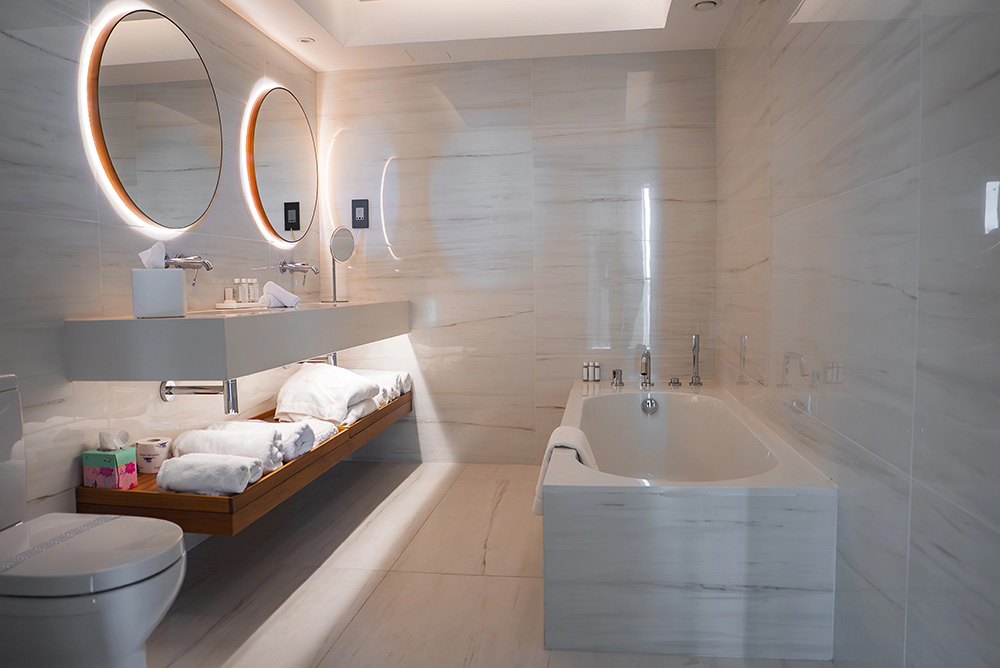
The bathroom is a multifunctional space where personal hygiene is performed, as well as self-care activities such as hair removal, applying makeup, or taking a relaxing bath. Therefore, it's important to provide shadow-free lighting to allow for good visibility of all the tasks performed in this space. It's also necessary to consider whether you want to create a more stimulating, relaxing, or both types of environment in this space.
In this article, we offer three tips for improving bathroom lighting.
1. General lighting
For general lighting, warm white light, which corresponds to less than 3300 Kelvin, can be used. This is a relaxing light with a tone between yellow and red that radiates warmth and heat. When used at night, it can also promote sleep quality.
Neutral white light, which ranges between 3300 and 5300 Kelvin, can also be used. This daytime white light can be more useful for starting the day full of energy. However, it should not be used at night, as it can disrupt the sleep-wake cycle. To overcome this issue, luminaires with a CCT function can be used, which allow the color temperature to be changed with the help of a dimmer or a touch switch integrated into the luminaire's structure.
Which light fixtures can be used?
Plafons or recessed spotlights can be installed. They provide essential light for most activities, such as showering and bathing, but also for simple orientation in the bathroom.
If you opt for recessed spotlights in the shower or bathtub area, you should install one or more to ensure good visibility, and they should have IP65 protection.
Smaller bathrooms will appear larger with recessed lighting, since it's integrated directly into the architecture and therefore doesn't take up space.
For general lighting, it is recommended that each item have 150 lumens/m².
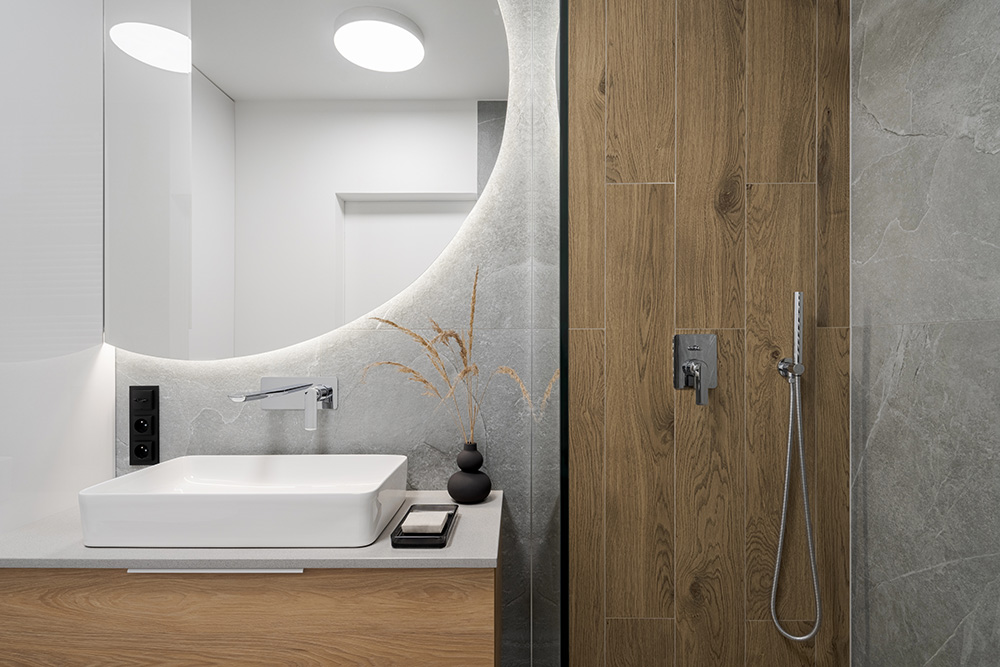
2. Task lighting
The area around the sink countertop and mirror requires specific lighting. Mirrors can be fitted with integrated lights. Alternatively, a wall light can be installed above the mirror, directing the light from top to bottom. Two wall lights can also be placed, one in the upper right corner and another in the left, or on the side walls of the mirror, thus achieving even illumination without shadows.
LED light luminaires have a particular advantage. They have a translucent diffuser made of plastic or opal glass above the light source. This ensures that the light is not dazzling and provides the best visual comfort for bathroom routines.
For this area, light fixtures with 400 to 800 lumens are recommended.
3. Cabinet lighting
If the layout allows, LED lights can be applied above and below the countertop. LED strips, for example, can be used for this purpose. These can be used on the sink countertop as well as on other cabinets, accentuating the design features of the furniture.
LED lights can also be used on shelves, as well as inside drawers, making it much easier to find what you're looking for, and to keep things organized and clean.
Here are some options for plafons and LED strips for the bathroom:
Plafons Philips
Plafons Ledvance
Plafons V-TAC
LED Strips V-TAC
If you have any questions, please do not hesitate to contact our experts via email at info@wattlamp.net.


