
Advantages of LED street lighting

The primary technology used in the past to illuminate urban areas was discharge lamps. Nowadays, we are increasingly seeing the application of LED technology.
The new LED lights are seen as brighter, making them safer. Some studies show a 100% improvement in peripheral vision while driving, improving driver reaction times by up to 25%.
Conventional technology for public lighting
Let's move on to analyzing the conventional discharge lamps that are still used today.
Incandescent light bulbs
Incandescent light bulbs, which operate by heating a metal filament encased in glass, are characterized by their low cost, good color rendering, and notable inefficiency. Only 10% of the energy consumed is transformed into light. Their lifespan is very short, and they need to be replaced very frequently.
Mercury vapor lamps
Mercury vapor lamps are better in terms of efficiency and lifespan compared to incandescent lamps. However, they emit an unpleasant blue-green light. They are very polluting, as they contain mercury. Part of the light they emit is ultraviolet.
Metal halide lamps
Metal halide lamps operate at high pressures and temperatures. The light they emit reproduces colors quite well. In addition to the initial connection time, if they are switched off, it is necessary to wait between 5 and 10 minutes before switching them back on. They contain mercury and lead.
Sodium vapor lamps
Sodium vapor lamps come in two different versions: high pressure (HPS) and low pressure (LPS). Their efficiency is excellent, but the light they provide is of low quality. The LPS version, for example, emits light at a single frequency of the spectrum, which prevents colors from being distinguished. Also, like other discharge lamps, lead and mercury are among their components.
Fluorescent lamps
Fluorescent lamps have an efficiency intermediate between incandescent and HPS alternatives, and became popular in the late 1930s. The light they provide is not very directional, which prevents the fixtures from being installed at higher heights. They also have the problem of containing mercury.
Compact fluorescent lamps
Compact fluorescent lamps are better known as energy-saving lamps or CFLs. They have good efficiency and CRI. Their lifespan is greatly reduced if on/off cycles are frequent. They also contain mercury, which makes them difficult to recycle.
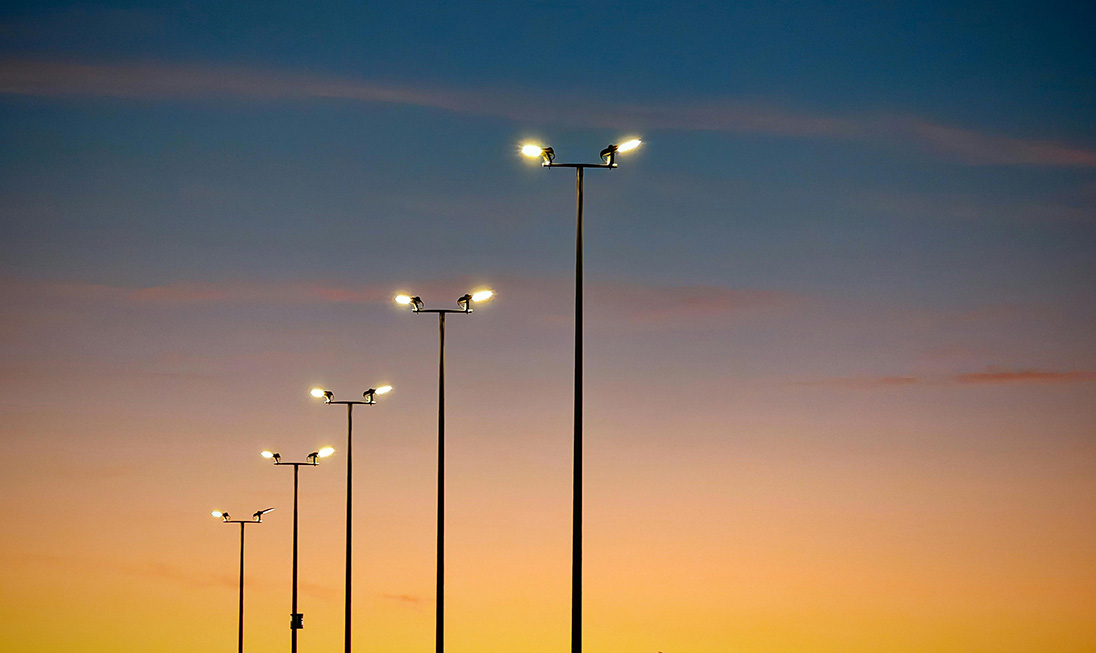
LED technology for street lighting
LED technology is highly efficient, durable, and contains no materials harmful to the environment. Initially, it was expensive, but currently it is more affordable. Its advantages include low energy consumption, high CRI (Color Rendering Index), dimming capability, directional lighting, and reduced light pollution.
We will now analyze LED lighting and lamp solutions using this technology.
LED street lighting luminaire
These luminaires offer energy savings of between 40% and 60%, compared to other technologies, such as metal halide or sodium vapor lamps.
From an environmental point of view, LED luminaires contribute to the reduction of CO2 emissions and light pollution, and do not contain elements that are hazardous to the environment, such as mercury.
Another advantage of these lights is that they do not emit UV or IR radiation and produce very little heat, which makes them less attractive to insects.

LED street lighting lamps
This is the most economical solution for improving public lighting, since the only element that is replaced is the lamp itself.
You can choose a wattage between 10W and 54W, depending on the lighting requirements of the environment and the height of the light fixture.
It is also important to consider where the light fixture is mounted and to choose a lamp with IP protection, if necessary.
The final factor to consider is the shape of the light fixture, in order to choose the correct beam angle to maximize light output. Typical beam angles are between 180° and 360°.
Improving street lighting increases comfort and safety on public roads and in communities.
To learn more about our street lighting options, please visit the following links:
If you have any questions, please do not hesitate to contact our experts at info@wattlamp.net.


