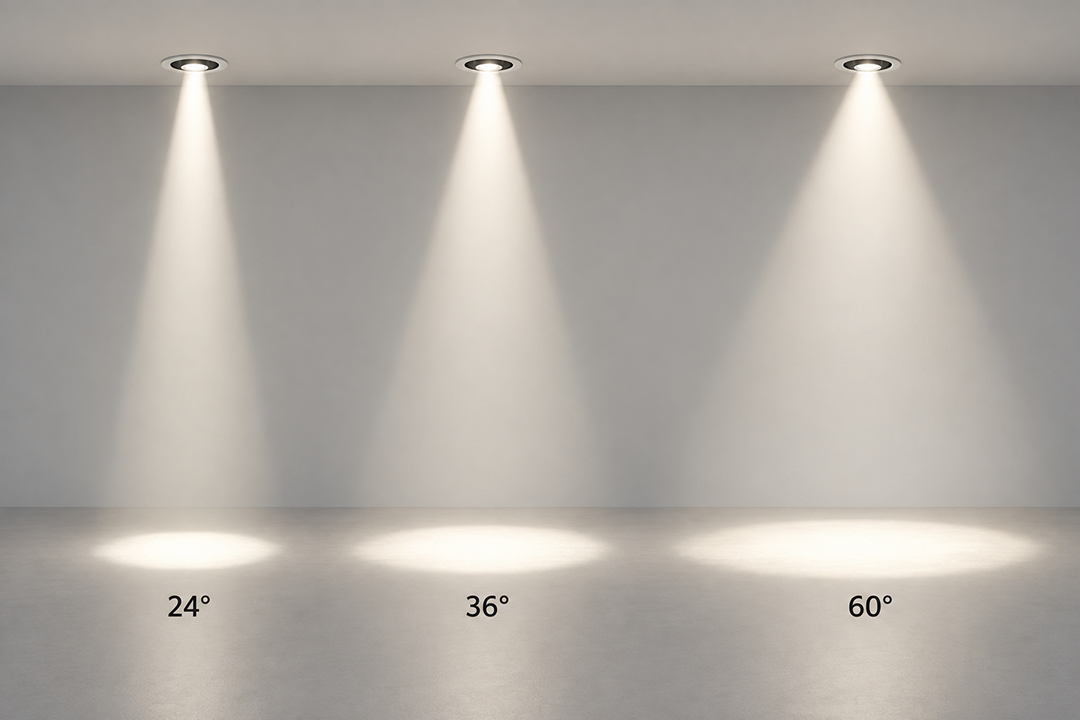
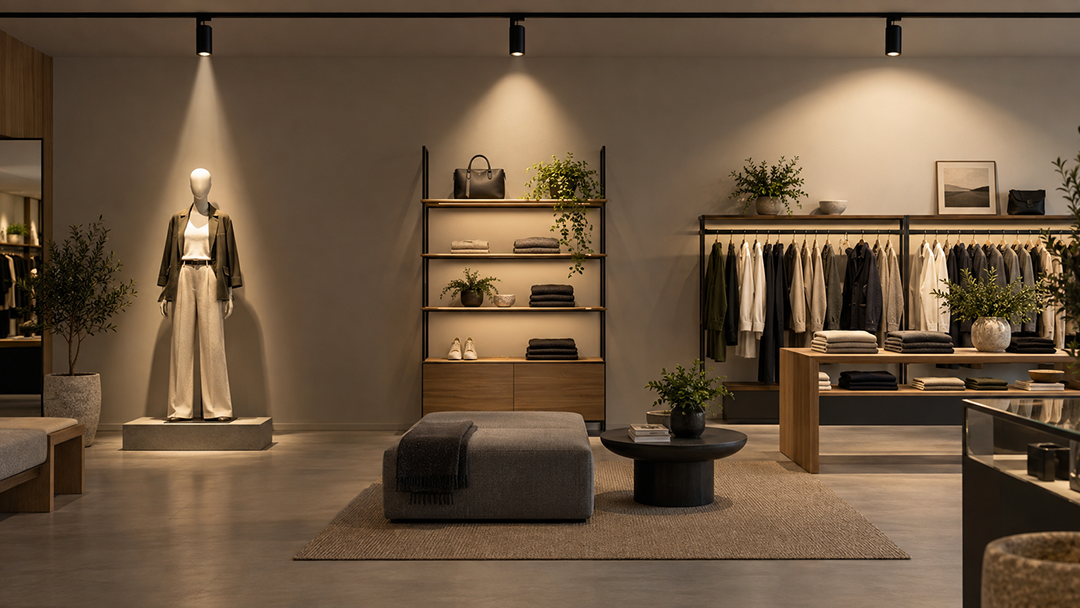
When choosing a lamp or luminaire, it is common to compare wattage, lumens and colour temperature. However, another specification also has a direct effect on the final result: the beam angle.
Two luminaires with the same lumen output can illuminate a space in very different ways. One may concentrate the light on a particular object, while the other distributes the same amount of light over a larger area.
What is the beam angle?
The beam angle indicates how widely the light is distributed from a lamp or luminaire.
A smaller angle creates a narrower, more concentrated beam. A larger angle spreads the light over a wider surface.
In technical specifications, this value is shown in degrees. Some product references may use the letter “D”, such as 24D, 36D or 60D.
In practical terms:
narrow angle: concentrates the light over a small area;
medium angle: balances concentration and distribution;
wide angle: distributes the light over a larger area.
The classifications used may vary between manufacturers. You should therefore check the exact number of degrees shown in the product specifications.
The same number of lumens can produce different results
Lumens indicate the total amount of light emitted, but they do not explain how that light is distributed.
A 500-lumen lamp with a narrow beam can produce a very bright central area. Another lamp with the same 500 lumens and a wider beam distributes the light over a larger surface, reducing the intensity at the centre.
This does not mean that one option is better than the other. The right choice depends on the area you want to illuminate and the effect you wish to achieve.
Up to 24°: narrow beam, suitable for highlighting objects, artwork, products, architectural features or small areas of a building façade;
Between 25° and 40°: medium beam, commonly used in spotlights, GU10 and AR111 lamps and retail lighting;
Between 41° and 60°: wider beam, suitable for general lighting or covering larger areas with fewer light sources;
Over 60°: very wide distribution, frequently used in ceiling lights, panels, some downlights and general lighting luminaires.
These ranges are only indicative. The result will also depend on the mounting height, wattage, lumen output and optical design of the luminaire.
Distance changes the illuminated area
The greater the distance between the luminaire and the surface, the larger the area covered by the beam. At the same time, the intensity of the light reaching that surface decreases.
For example, at a distance of approximately 2.5 metres:
a 36° beam may create an illuminated area approximately 1.6 metres in diameter;
a 60° beam may cover approximately 2.9 metres in diameter.
These figures are approximate and help to illustrate the difference. In a real installation, the edges of the beam do not form a perfectly defined circle, and the distribution will vary depending on the optics.
Which beam angle is suitable for each application?
Homes
For general lighting in living rooms, kitchens and corridors, a medium or wide beam can help create a more uniform distribution.
Narrow beams can be used to highlight artwork, walls, furniture or decorative features.
Shops and display windows
In retail environments, general lighting is often combined with more concentrated beams directed at products and displays.
In addition to the beam angle, colour rendering should also be considered, particularly for clothing, food, interior decoration and cosmetics.
Offices and work areas
Lighting should be uniform and avoid areas that are excessively bright or dark. Wider beams can make distribution easier, but luminaire positioning and glare control remain essential.
Façades and outdoor areas
A narrow beam can highlight a particular feature or reach a more distant surface. A wider beam may be more suitable for entrances, gardens, car parks and circulation areas.
In outdoor spaces, the direction of the light should also prevent unnecessary spill towards the sky, neighbouring properties or areas where it could cause glare.
Spacing between luminaires is important
Good lighting does not depend only on the angle of each luminaire. The distance between the different light sources must also be considered.
If luminaires are placed too far apart, dark areas may appear between the beams. If they are too close together, they may create areas that are excessively bright.
The aim is to achieve balanced overlap, especially when uniform general lighting is required.
Still have questions?
Send us a photograph or floor plan of the space and provide the dimensions, mounting height and area you want to illuminate.
The Wattlamp team can help you assess the beam angle, lumen output and other specifications required to find a suitable solution.