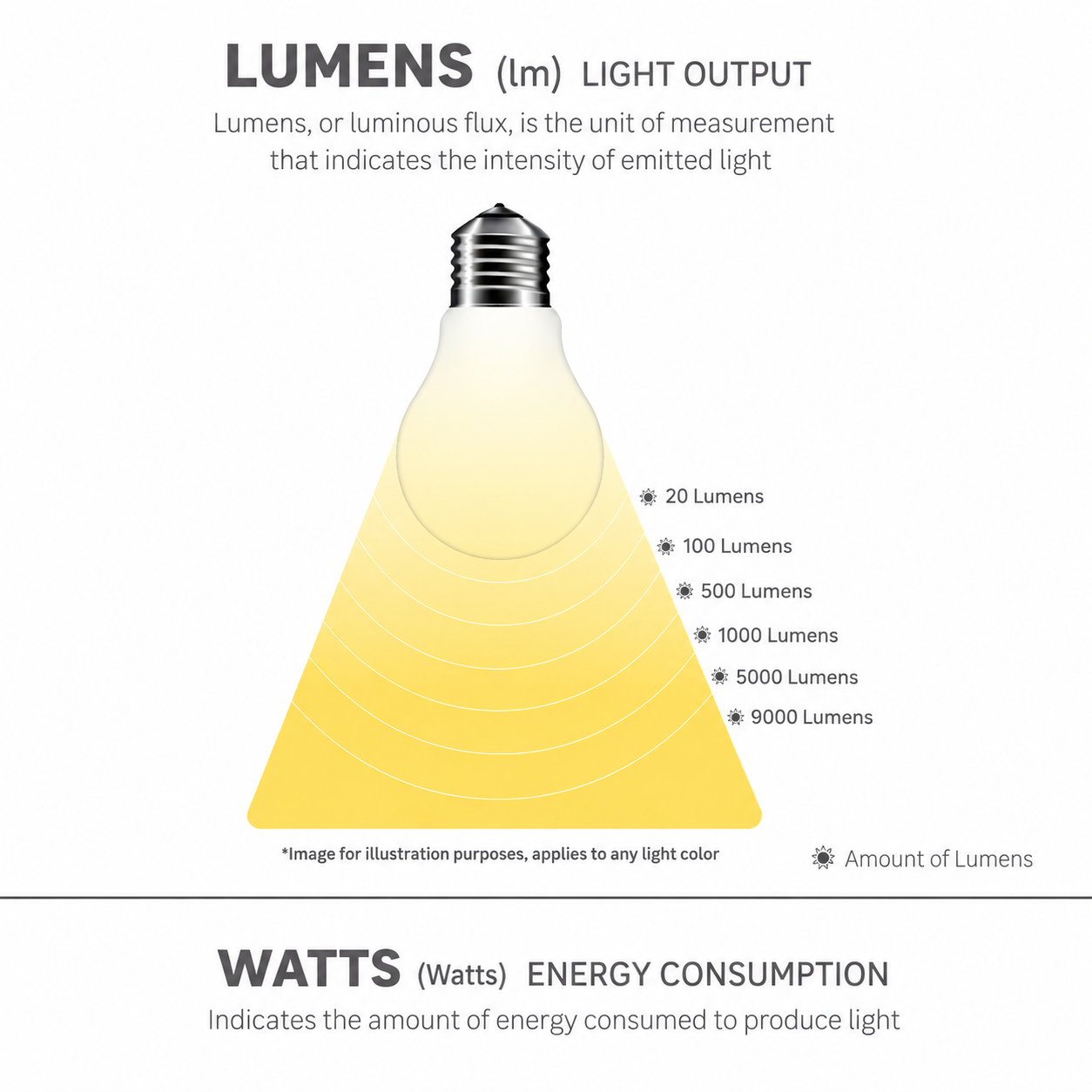
When choosing a lamp or luminaire, it's common to wonder about the difference between Watts (W) and Lumens (lm). Although both are related to lighting, they measure completely different things and are equally important when selecting the right product.
In the past, simply looking at the wattage was enough to estimate how much light a lamp would produce. However, with the development of LED technology, this is no longer the case. Today, an LED lamp can consume much less energy while producing significantly more light than a traditional lamp.
A Watt (W) is the unit used to measure a light source's energy consumption. In other words, it indicates how much electricity is required to operate the product, but not how much light it emits.
A Lumen (lm), on the other hand, measures the luminous flux, which is the amount of visible light produced by a lamp or luminaire. The higher the number of lumens, the brighter the light output.
When comparing lighting products, the best option is one that delivers the highest number of lumens while consuming the fewest watts. This means greater energy efficiency, lower electricity consumption and reduced energy costs.
In summary, Watts measure energy consumption, while Lumens measure light output. Understanding the difference is essential for choosing the most suitable lighting solution for any space, ensuring maximum efficiency without compromising lighting quality or visual comfort.